Taxes & Credit Cards: A Practical Guide to Understanding Credit, Interest, Fees and Tax Basics
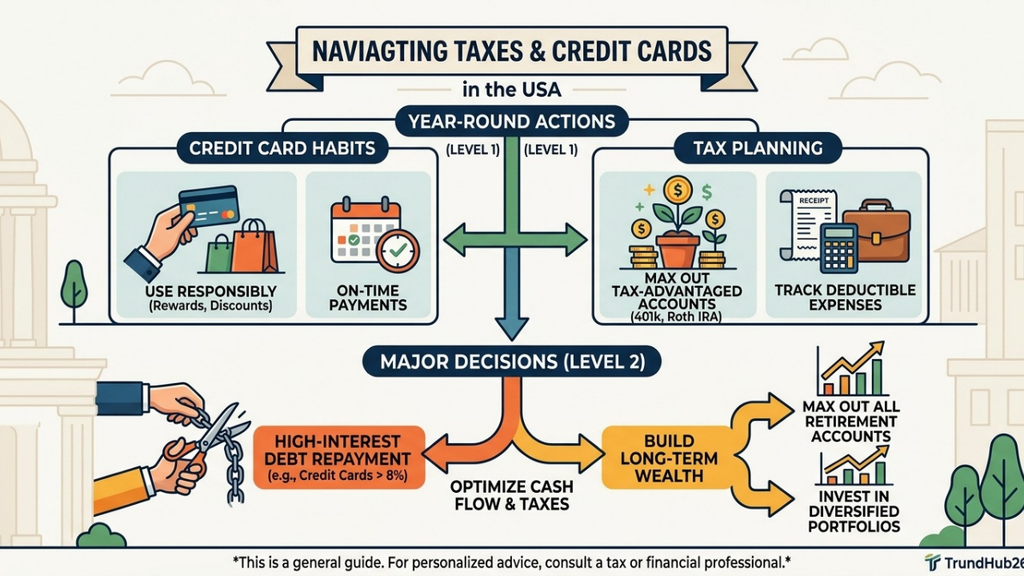
Credit cards and taxes are two parts of personal finance that many people deal with every year, yet both can be surprisingly confusing.
A credit card can be a convenient way to pay for everyday purchases, manage short-term expenses, or build a credit history. At the same time, tax rules can affect income, deductions, investments, retirement accounts, and other financial decisions.
Understanding the basics can make it easier to manage your money and ask the right questions when you need help.
At TrundHub26, our goal is to make financial topics easier to understand through practical, straightforward information. This page explains important credit-card terms, responsible card management, interest and fees, common tax considerations, and the connection between everyday financial decisions and your broader financial plan.
This information is intended for general education. Tax rules and credit-card terms can change, and individual circumstances are different, so important decisions should be verified with the appropriate government source, card issuer, tax professional, or other qualified professional.
Understanding How Credit Cards Work
A credit card is a form of revolving credit. Instead of borrowing a fixed amount once and making a set number of payments, you generally receive a credit limit and can use the available credit for eligible purchases.
As you make purchases, the amount available to you can decrease. Payments can restore some or all of that available credit, depending on your account terms.
Credit cards can be useful when managed responsibly, but they can also become expensive when balances are carried at high interest rates.
Before using a credit card, it is important to understand the card’s interest rate, fees, payment requirements, rewards terms, and other conditions.
What Is APR?
APR stands for Annual Percentage Rate.
For credit cards, the APR helps describe the cost of borrowing. A card can have more than one APR because different types of transactions may have different rates.
For example, purchases, balance transfers, and cash advances can have different terms.
The Consumer Financial Protection Bureau explains that credit-card agreements disclose APRs and applicable fees, and promotional APRs may apply only for a limited period.
This is why it is important to look beyond an advertisement that simply says “low rate.”
If a promotional rate is offered, find out when it ends and what rate may apply afterward.
Credit Card Interest and Grace Periods
Interest is one of the most important costs to understand when using a credit card.
Some cards offer a grace period for purchases. When the applicable requirements are met and the balance is paid in full by the due date, a cardholder may be able to avoid interest on those purchases.
However, the rules can vary by card and transaction type.
Some credit-card companies calculate interest using a daily periodic rate and an average daily balance. Cash advances and other transactions may have different interest rules.
The CFPB recommends understanding the specific terms of your card agreement rather than assuming every transaction is treated the same way.
If you regularly carry a balance, the interest rate becomes particularly important because interest can add significantly to the cost of purchases.
Minimum Payments: What They Really Mean
Your credit-card statement normally shows a minimum payment and a payment due date.
The minimum payment is the amount you are required to pay by the due date to keep the account in compliance with the payment requirement.
However, paying only the minimum can result in a balance remaining for a long time, especially when the account has a high interest rate.
The CFPB notes that credit-card statements can show an estimate of how long it could take to pay off a balance if only minimum payments are made and no additional purchases are added.
Paying more than the minimum, when affordable, can reduce the balance faster and may reduce the total interest paid.
The key is to make payments that fit realistically within your budget.
Credit Utilization and Your Credit Profile
Credit utilization generally refers to how much of your available revolving credit you are using.
For example, if your credit limit is $5,000 and your balance is $1,000, your utilization is 20%.
Credit utilization is one factor that can be considered by credit-scoring models, although credit scores are calculated using multiple pieces of information.
There is no single utilization percentage that guarantees a particular credit score.
Instead of chasing a specific number, focus on responsible borrowing, timely payments, manageable balances, and reviewing your credit reports for accuracy.
Balance Transfers
A balance transfer allows a borrower to move debt from one credit card to another, subject to the terms of the cards involved.
Some cards advertise promotional or low introductory rates for balance transfers.
However, a balance-transfer offer may include a fee, and the promotional rate normally lasts for a limited period.
The CFPB notes that balance transfers can involve fees and that the interest rate may increase after the promotional period ends.
Before transferring a balance, compare the transfer fee, promotional period, regular APR, payment requirements, and other conditions.
A balance transfer should not be viewed as automatically eliminating debt. It simply changes where the balance is held.
Credit Card Fees to Watch
Interest is not the only cost associated with a credit card.
Depending on the card, fees may include:
- Annual fees
- Balance-transfer fees
- Cash-advance fees
- Foreign-transaction fees
- Late-payment fees
- Other account-related charges
Some cards offer rewards or benefits in exchange for an annual fee. Whether those benefits are worthwhile depends on how you use the card.
A card with a higher reward rate is not necessarily a better financial choice if the annual fee and interest costs outweigh the benefits.
Always review the cardholder agreement and current fee information before applying.
Credit Cards and Responsible Spending
A credit card should not be treated as extra income.
Every purchase creates an obligation that must eventually be paid.
Before using a card, consider whether the purchase fits within your normal budget.
If you regularly use credit to pay for expenses that you cannot afford from your available cash flow, the balance can become difficult to manage.
One useful habit is to review your card statements regularly.
Look for unfamiliar transactions, unexpected fees, changes in terms, and spending patterns that may be putting pressure on your budget.
If you cannot make the required payment, contact the card issuer as soon as possible. The CFPB advises consumers who are struggling with payments to contact their card company and discuss possible options rather than ignoring the problem.
Credit Cards and Your Credit History
Responsible credit-card use can be part of building a credit history.
Payment history, balances, length of credit history, new credit activity, and other information can affect credit scoring.
However, a credit card should not be opened simply because someone promises that it will produce a specific credit-score increase.
Credit outcomes vary between individuals.
The most useful approach is to develop consistent financial habits: make payments on time, understand your balances, avoid taking on unnecessary debt, and monitor your credit information.
Understanding Taxes and Personal Finance
Taxes are another important part of financial planning.
Your federal tax situation can depend on factors such as income, filing status, deductions, credits, investments, retirement contributions, business activity, and other circumstances.
State and local taxes may also apply depending on where you live and the type of income or transaction involved.
Because tax rules can be complicated, online financial articles should be used as educational resources rather than substitutes for personalized tax advice.
When dealing with a significant tax question, use current information from the Internal Revenue Service or consult an appropriately qualified tax professional.
Are Credit Card Purchases Tax-Deductible?
A common misunderstanding is that using a credit card automatically makes a purchase tax-deductible.
That is not generally how tax deductions work.
The fact that you paid for something with a credit card does not, by itself, make the expense deductible.
Whether an expense has tax consequences depends on the nature of the expense, how it was incurred, who incurred it, and the applicable tax rules.
For example, certain legitimate business expenses may receive different tax treatment from ordinary personal purchases.
Because tax treatment can depend on individual circumstances, do not assume that a credit-card purchase qualifies for a deduction simply because it appears on a statement.
Keep appropriate records and verify tax questions using current IRS guidance or professional advice.
Credit Card Rewards and Taxes
Credit-card rewards can also raise tax questions.
Rewards programs can have different structures, and the tax treatment may depend on how rewards are earned and the circumstances involved.
Consumers should not automatically assume that every cash-back payment, travel reward, sign-up incentive, or promotional benefit receives identical tax treatment.
If rewards are significant or connected with business activity, keep accurate records and check the applicable tax rules.
The safest approach is to look at the actual terms of the reward program and obtain current tax guidance when necessary.
Keeping Good Financial Records
Good recordkeeping can make both credit management and tax preparation easier.
Consider keeping copies of important financial documents, including:
- Credit-card statements
- Loan statements
- Receipts for important purchases
- Business expense records
- Tax documents
- Investment records
- Insurance documents
- Mortgage documents
- Records of major financial transactions
Digital records can be useful, but important documents should be stored securely.
Organizing records throughout the year can be much easier than trying to reconstruct everything when a tax deadline approaches.
Credit Cards and Business Expenses
Business owners may use credit cards to pay for legitimate business expenses.
Keeping business and personal spending separate can make financial recordkeeping easier and may help when preparing business records or discussing expenses with a tax professional.
However, putting an expense on a business credit card does not automatically make it deductible.
The underlying expense and applicable tax rules still matter.
Business owners should maintain appropriate documentation and seek professional advice when they are unsure how an expense should be treated.
What to Check Before Applying for a Credit Card
Before applying for a new credit card, consider the following:
1. APR
Find out the regular APR and whether different APRs apply to different transaction types.
2. Promotional Rate
If an introductory APR is offered, determine exactly when it ends and what happens afterward.
3. Annual Fee
Calculate whether the benefits are likely to justify the annual cost.
4. Balance Transfer Terms
Check the transfer fee and promotional period before moving existing debt.
5. Cash Advance Costs
Cash advances can have different fees and interest terms from ordinary purchases.
6. Rewards
Look at how rewards are earned, redeemed, limited, or potentially forfeited.
7. Payment Requirements
Understand the minimum payment and due date.
8. Other Fees
Review the complete fee schedule instead of relying only on the headline offer.
How to Use Credit Cards More Carefully
A few simple habits can make credit-card management easier.
Pay attention to your statement every month.
Set reminders for payment due dates.
Avoid spending beyond what you can realistically repay.
Review your balance before making large purchases.
Understand promotional offers before accepting them.
Keep track of annual fees and other recurring charges.
And if you are having difficulty making payments, communicate with your card issuer rather than waiting until the situation becomes more serious.
These habits do not guarantee a particular credit score or financial result, but they can help you understand and manage your credit more deliberately.
Taxes, Credit and Your Overall Financial Plan
Taxes and credit cards should not be viewed as completely separate topics.
Your financial decisions can affect your cash flow, savings, debt obligations, and ability to meet other goals.
For example, high-interest credit-card debt can consume money that might otherwise be available for savings or other priorities.
Likewise, poor recordkeeping can make it more difficult to understand your overall financial position.
A simple financial plan should consider income, spending, debt, savings, insurance, taxes, and longer-term goals together.
You do not need a complicated system.
Start by understanding where your money goes, what you owe, what you own, and what financial obligations are coming next.
TrundHub26: Financial Information Made Easier to Understand
TrundHub26 provides educational information about credit cards, taxes, loans, mortgages, insurance, personal finance, and business financing.
Our objective is to explain financial concepts in clear language so readers can better understand the questions they should ask before making a financial decision.
We do not promise a particular credit score, tax result, credit-card approval, loan approval, interest rate, savings amount, or financial outcome.
Where financial products or services are discussed, readers should review the provider’s current terms and conditions before applying or making a commitment.
Our content is designed to support informed research, not replace professional advice.
Final Thoughts
Credit cards can be useful financial tools when they are understood and used responsibly.
The most important things to understand are not just the advertised rewards or introductory offer, but the APR, fees, payment requirements, promotional period, and long-term cost.
Taxes require a similar level of attention.
A financial decision that appears simple can have different consequences depending on your individual circumstances.
Good financial habits start with asking questions, reading the terms, keeping accurate records, and checking information against reliable sources.
At TrundHub26, we aim to make that process easier by providing practical financial education in straightforward language.
Important Disclaimer
The information on this page is provided for general educational and informational purposes only. It is not personalized tax, legal, financial, credit, investment, lending, or accounting advice.
Tax laws, regulations, credit-card terms, fees, interest rates, and financial products can change. Rules may also differ based on individual circumstances and location.
TrundHub26 does not guarantee credit-card approval, loan approval, tax savings, credit-score improvements, financial returns, or any other specific outcome.
Before making an important financial or tax decision, verify current information with the appropriate government agency, financial institution, card issuer, lender, or qualified professional.
Sources & Further Reading
For current information about credit cards and consumer financial rights, readers can consult the Consumer Financial Protection Bureau.
For current federal tax information, readers should consult the Internal Revenue Service and other applicable official government resources.
TrundHub26 will make reasonable efforts to keep educational content useful and current, but readers should verify time-sensitive information before taking action.