Complete Guide to Personal Finance: Credit, Debt, Investing, Insurance & Home Financing
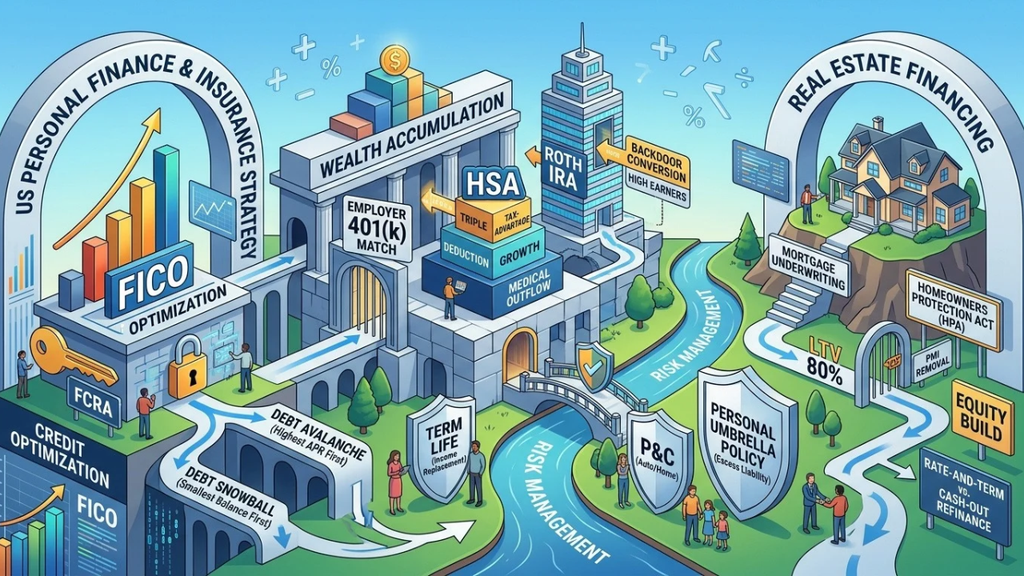
Managing money becomes much easier when you understand how the different pieces of your financial life fit together. Your credit history can affect borrowing costs, a sensible debt strategy can help free up monthly cash flow, investing can help build long-term wealth, and insurance can protect you from unexpected financial setbacks. For homeowners, choosing the right type of mortgage can also make a significant difference over many years.
Personal finance is not about finding one perfect financial product or following a complicated formula. It is about making informed decisions based on your income, expenses, goals, risk tolerance, and circumstances.
This guide explains several important areas of personal finance in straightforward language. It is designed to provide general educational information rather than individualized financial, tax, legal, or insurance advice.
Understanding Your Credit Score
Your credit history is an important part of the borrowing process in the United States. Lenders may review your credit information when you apply for a credit card, auto loan, mortgage, or other forms of credit. Your credit profile can also affect the interest rate and terms you may be offered.
Several credit-scoring models are used in the United States. FICO and VantageScore are two widely recognized scoring systems. Although their formulas are not identical, they generally consider information such as payment behavior, credit utilization, the age of accounts, new credit activity, and the types of credit in a person’s profile.
Payment History
Making payments on time is one of the most important habits for maintaining a healthy credit profile. A missed or late payment can negatively affect your credit history, particularly when it becomes seriously delinquent.
If you are having trouble making a payment, contacting the lender before the account becomes seriously past due may be worthwhile. Different lenders have different policies, so do not assume that a particular solution will be available.
Credit Utilization
Credit utilization refers to how much of your available revolving credit you are using.
For example, if your credit cards have a combined limit of $10,000 and your balances total $3,000, your utilization is 30%.
A lower utilization ratio is generally viewed more favorably by many scoring models, although there is no single percentage that guarantees a particular credit score. Rather than focusing only on a specific target, concentrate on paying balances responsibly and avoiding debt that you cannot comfortably afford.
Checking Your Credit Reports
Reviewing your credit reports can help you identify inaccurate or incomplete information. Consumers can obtain credit reports through the federally authorized AnnualCreditReport.com service.
If you find information that you believe is inaccurate, you generally have the right to dispute it with the appropriate credit reporting company and the business that supplied the information. The Consumer Financial Protection Bureau explains that disputes should identify the information being challenged and include supporting documentation when available.
Do not pay someone simply because they promise to remove accurate negative information from your credit history. Be cautious about services that guarantee a specific credit-score increase.
Choosing a Debt Repayment Strategy
Debt can become easier to manage when you have a clear repayment plan. Two commonly discussed approaches are the debt avalanche and debt snowball methods.
Debt Avalanche
With the debt avalanche method, you continue making the required payments on all debts while putting additional money toward the debt with the highest interest rate.
Once that debt is paid off, you redirect the money toward the next highest-rate balance.
The potential advantage is that paying expensive debt first can reduce the amount of interest paid over time.
Debt Snowball
The debt snowball method focuses on the smallest balance first, regardless of the interest rate.
After paying off the smallest balance, you use the money that had been going toward it to attack the next balance.
This approach may not always minimize total interest, but some people find the quick progress motivating.
The better strategy is usually the one you can follow consistently while still meeting your required payments.
Balance Transfers and Consolidation Loans
A balance-transfer credit card may offer a temporary promotional interest rate. However, these offers can include fees and conditions, and the promotional period eventually ends.
A debt-consolidation loan may combine multiple balances into one payment. Before using one, compare the interest rate, fees, repayment period, and total cost rather than looking only at the monthly payment.
A lower monthly payment is not automatically a better deal if the repayment period becomes substantially longer.
Building Savings Before Taking More Investment Risk
Investing can be an important part of long-term financial planning, but it is generally helpful to establish a reasonable cash reserve first.
An emergency fund can provide money for unexpected expenses such as a major repair, temporary loss of income, or another financial emergency. The appropriate amount depends on a person’s income, expenses, job stability, and responsibilities.
Once your basic financial foundation is in place, you can consider how investing fits into your longer-term goals.
Using Tax-Advantaged Retirement Accounts
The U.S. tax system provides several accounts designed to support retirement and certain other financial goals. Eligibility rules, contribution limits, tax treatment, and other requirements can change, so current IRS information should be checked before making decisions.
Employer Retirement Plans
If your employer offers a retirement plan such as a 401(k), 403(b), or 457(b), understand how the plan works and whether the employer provides matching contributions.
An employer match can be an important benefit, but the specific rules vary by employer and plan.
Health Savings Accounts
Eligible individuals may also have access to a Health Savings Account, commonly called an HSA.
HSAs have special tax characteristics, including potential tax advantages for contributions, investment growth, and qualified medical withdrawals. However, eligibility depends on the type of health coverage you have and other requirements.
Because tax rules can be complicated, check current IRS guidance or consult a qualified tax professional before making decisions based on tax treatment.
Traditional and Roth IRAs
Traditional and Roth individual retirement accounts can provide different tax advantages.
With a Traditional IRA, contributions may be deductible depending on your circumstances, while withdrawals are generally subject to applicable tax rules.
With a Roth IRA, contributions are generally made with after-tax money, and qualified withdrawals can receive tax-free treatment.
Income limits, contribution rules, and other requirements apply. Before using an IRA strategy, make sure you understand the rules that apply to your situation.
Investing for the Long Term
Investing always involves risk. Investments can lose value, and past performance does not guarantee future results.
Instead of trying to predict which investment will rise next, many long-term investors focus on diversification, costs, time horizon, and an asset allocation that matches their ability and willingness to accept market fluctuations.
Broadly diversified funds can provide exposure to many companies or securities through a single investment, but diversification does not eliminate risk.
Your investment approach should reflect the purpose of the money. Money needed in the near future may require a different approach from money being invested for a retirement goal many years away.
Avoid financial content that promises guaranteed investment returns or suggests that a particular investment cannot lose money. Such claims can be misleading and do not reflect the normal risks of investing.
Protecting Your Finances With Insurance
Saving and investing can build wealth, but insurance serves a different purpose: protecting you from potentially large financial losses.
Life Insurance
Life insurance can provide financial support to beneficiaries after the insured person’s death.
Term life insurance provides coverage for a specified period. Permanent policies, including whole life and certain universal life policies, can provide longer-term coverage and may have a cash-value component.
The appropriate type and amount of coverage depend on factors such as income, dependents, debts, assets, and financial goals.
There is no single insurance policy that is right for everyone.
Auto and Homeowners Insurance
Auto and homeowners insurance can help protect against covered losses and liability.
When comparing policies, do not look only at the monthly premium. Review deductibles, coverage limits, exclusions, and other important terms.
For homeowners, the amount needed to rebuild a property may differ from its market value. Understanding what the policy actually covers can help prevent unpleasant surprises after a loss.
Umbrella Liability Insurance
A personal umbrella policy can provide additional liability protection above certain underlying insurance policies.
It may be worth considering for people with substantial assets, significant income, rental properties, or other circumstances that increase their exposure to liability claims.
Coverage requirements and availability vary by insurer and state.
Health Insurance
Health insurance plans can differ significantly in premiums, deductibles, copayments, coinsurance, provider networks, and out-of-pocket limits.
When comparing plans, looking only at the monthly premium may give an incomplete picture.
Consider the total potential cost of coverage, including what you could have to pay yourself during a year with significant medical expenses.
Understanding Mortgages and Home Financing
Buying a home is one of the largest financial decisions many people make. The mortgage itself is only one part of the total cost of homeownership.
Property taxes, homeowners insurance, maintenance, utilities, closing costs, and potential repairs should also be considered when determining whether a property fits your budget.
Debt-to-Income Ratio
Lenders commonly evaluate debt-to-income ratio, or DTI, when reviewing mortgage applications.
DTI compares certain monthly debt obligations with gross monthly income. Different loan programs and lenders can have different requirements, so a particular DTI percentage should not be treated as a universal approval rule.
Credit history, income, down payment, assets, loan type, property characteristics, and other factors may also influence mortgage eligibility and pricing.
Down Payments and Mortgage Insurance
A larger down payment can reduce the amount borrowed, although the right down payment depends on your financial circumstances.
For some conventional mortgages, borrowers who put less than 20% down may have to pay private mortgage insurance, commonly called PMI.
PMI protects the lender rather than the borrower. Certain cancellation rules may apply depending on the loan and the borrower’s circumstances.
Before choosing a mortgage, ask the lender how mortgage insurance works, when it may be removed, and what conditions apply.
Fixed-Rate and Adjustable-Rate Mortgages
A fixed-rate mortgage generally keeps the same interest rate for the agreed loan term, which can make monthly principal-and-interest payments easier to plan.
An adjustable-rate mortgage, or ARM, can have an initial rate that later changes according to the terms of the loan.
If you are considering an ARM, understand the initial period, adjustment frequency, index, margin, caps, and maximum possible payment.
Do not choose a mortgage solely because the initial payment appears lower.
Refinancing
Refinancing replaces an existing mortgage with a new loan.
A refinance may be considered when interest rates, loan terms, financial circumstances, or other factors make a new loan potentially beneficial.
However, refinancing can involve closing costs and other expenses.
One simple way to evaluate the decision is to compare the total refinancing costs with the expected monthly savings and estimate how long it would take to recover those costs.
If you expect to sell or move before reaching the break-even point, refinancing may not provide the expected benefit.
Bringing Your Financial Plan Together
Credit, debt, savings, investments, insurance, and housing decisions are connected.
Improving one area can sometimes make another area easier to manage. For example, reducing high-interest debt may create additional monthly cash flow. Building an emergency fund can reduce the need to rely on credit when an unexpected expense occurs. Appropriate insurance can help protect savings from a major covered loss.
A practical starting point is to understand where your money goes each month.
Review your income, essential expenses, debt payments, savings, insurance, and financial goals. Then prioritize the areas that need the most attention.
You do not have to change everything at once.
A realistic plan might begin with reviewing your credit reports, creating a basic emergency reserve, paying required bills on time, addressing expensive debt, and taking advantage of available employer retirement benefits.
Once those foundations are stronger, you can review longer-term investment and home-financing decisions.
Key Takeaways
Personal finance is a long-term process rather than a one-time decision.
The most useful habits are often simple:
- Review your credit reports regularly.
- Pay required bills on time.
- Understand the cost of your debt.
- Build an emergency savings reserve.
- Learn how your retirement accounts work.
- Diversify investments according to your goals and risk tolerance.
- Review insurance coverage and policy limits.
- Understand the complete cost of homeownership before purchasing.
- Compare financial products based on total cost, not just monthly payments.
- Verify important financial and tax information using reliable sources.
Most importantly, avoid financial decisions based solely on headlines, social-media claims, or promises of guaranteed results. Financial products can have fees, risks, eligibility requirements, and legal or tax consequences that differ from one person to another.
Important Disclaimer
This article is provided for general educational and informational purposes only. It is not personalized financial, investment, tax, legal, mortgage, credit, or insurance advice.
Financial products and services involve risks, costs, eligibility requirements, and terms that can vary by provider, state, and individual circumstances. Information, laws, contribution limits, interest rates, and other financial rules can change over time.
Before making an important financial decision, consider reviewing current information from the appropriate government agency, financial institution, insurer, lender, or other qualified professional.
We do not guarantee approval for loans, credit cards, mortgages, insurance policies, investment returns, or any other financial product or service.
Editorial Transparency
Our goal is to publish clear, useful, and understandable personal-finance information. Articles should be reviewed and updated when important rules or financial information change.
Where appropriate, readers should be directed to authoritative sources such as government agencies and regulatory organizations rather than being asked to rely solely on this website.
This website may receive compensation from certain advertising, referral, or partner relationships where applicable. Any such relationship should not be presented as an endorsement or guarantee of a financial product.
Readers should review the terms, fees, eligibility requirements, and risks of any financial product directly with the provider before applying or making a financial decision.