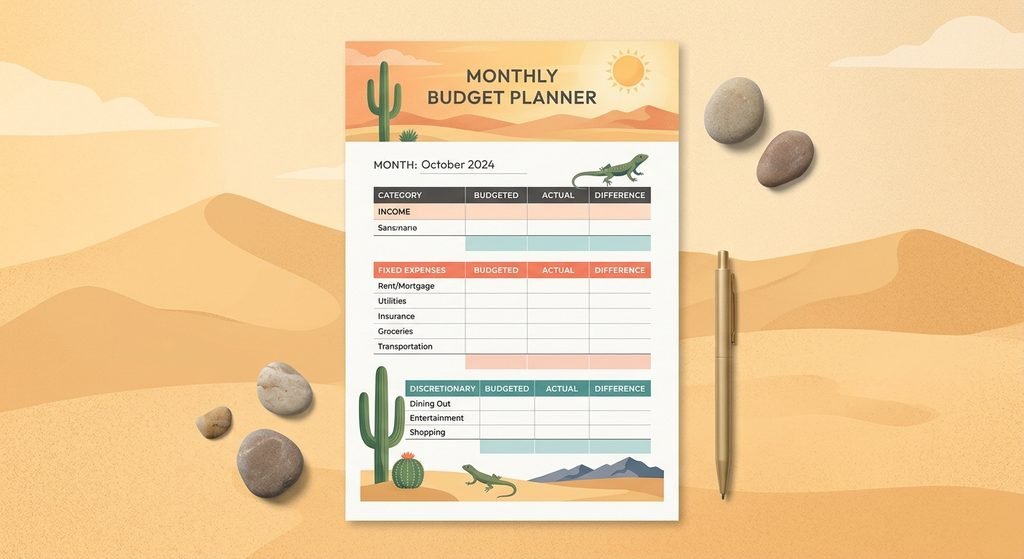
Learning How to Create an Easy Monthly Budget in Arizona. is essential for managing the state’s unique cost-of-living factors, from summer electric bills to housing costs.
If you live in Arizona, you may have looked at your bank balance in July and wondered where the money went. You probably did nothing wrong. Arizona has costs that don’t show up in generic budgeting advice: air conditioning that runs for months, a car you can’t really live without, and rent that has changed a lot over the past few years.
This guide shows you how to build a monthly budget that fits life here. It includes real figures, two worked examples, and the mistakes we see most often. Use your own numbers where they differ from ours. A budget only works if it matches your actual life.
Key takeaways
- Arizona’s low state income tax doesn’t make the state cheap. Housing, cooling, and car costs usually decide whether a budget works.
- Budget your electric bill as a yearly average, not as whatever last month’s bill was.
- Build a small “sinking fund” for the yearly costs that hit all at once, such as registration, A/C repairs, and car insurance renewals.
- Expect your income to be a number you verify on your paystub, not an estimate from a tax calculator.
Why budgeting in Arizona has its own challenges
Housing is the biggest line, and it varies a lot by city. Recent listing data puts the average Phoenix rent around $1,479 a month across all unit sizes, with Tucson near $1,202, Mesa around $1,468, Tempe near $1,781, and Scottsdale around $2,101 (RentCafe’s city comparison). Other sources report different averages, and Zumper’s median for a Phoenix one-bedroom was closer to $1,200 (down about 7% from the prior year). The takeaway is not one number. Rents have eased in much of the Valley, but they are still well above where they were in 2019, and you should check current listings for your neighborhood. rentcafezumper
Summer electric bills can be double your winter bills. One estimate puts a typical Phoenix household at about $165 a month, with summer bills routinely reaching $300 to $400 or more. The same source reports that APS has requested a 9.8% residential increase for 2027, with hearings scheduled for the fourth quarter of 2026. SRP, which serves much of the East Valley, had a different situation: it proposed a 3% reduction for May through October 2026. Your utility, home size, and A/C efficiency make a big difference. Phoenix Electricity Rates +2
Driving is not optional for most people. Car insurance estimates vary by source, but one 2026 analysis puts Phoenix full coverage at about $181 a month versus about $141 in Tucson. Arizona’s minimum liability requirement is 25/50/15, but a minimum policy doesn’t cover damage to your own car. moneygeekcompare
Wages are rising, which helps, but costs rise too. Arizona’s minimum wage is $15.15 an hour in 2026, with higher local rates in Flagstaff ($18.35) and Tucson ($15.45), and it adjusts automatically each January 1 for inflation. That is good news for workers, but it also means your budget should be reviewed every January. hivedeskhivedesk
The state income tax is low. Arizona uses a flat 2.5% income tax rate, and Social Security benefits are not taxed by Arizona. That helps, but federal taxes, payroll taxes, and sales tax (called TPT here) still come out of your money. breakevenpages
Step-by-step: build your Arizona monthly budget
Step 1: Find your real monthly take-home pay
Start with what actually lands in your bank account, not your salary. Use the net pay on your most recent paystub. If you’re paid every two weeks, multiply by 26 and divide by 12 (not by two paychecks a month), because you’ll get two “extra” paychecks in some months.
If your income varies, such as gig work, tips, or seasonal work, use the lowest month from the past six months as your baseline. Treat anything above that as bonus money you assign later. If you earn tips, note that Arizona’s tipped cash wage is $12.15 an hour in 2026, as long as tips bring you up to $15.15, so your pay can swing more than a regular hourly wage. hivedesk
Step 2: List your fixed costs
Fixed costs stay roughly the same every month: rent or mortgage, car payment, insurance, internet, phone, loan minimums, and childcare. Pull these from your bank and card statements for the last three months. Write down the real number, not what you wish it was.
Step 3: Estimate your variable costs
These change month to month: groceries, gas, dining out, entertainment, clothes, and household items. Use a three-month average. For each category, write down the average and the highest month.
Step 4: Smooth out your electric bill
This is the most Arizona-specific step. Take your last 12 months of electric bills, add them up, and divide by 12. Budget that number every month, and move the difference into savings during cooler months so it’s there for July and August.
Here is an illustration (not your bill): if you pay about $110 for six winter months, $200 in May and October, and $320 for June through September, the yearly total is $2,340, or about $195 a month. In winter you’d set aside about $85 a month, and in summer you’d draw it back down. Ask your utility about budget billing or time-of-use plans, since either may help you plan.
Step 5: Add a “sinking fund” for yearly costs
A sinking fund is money you set aside monthly for costs that come only a few times a year. In Arizona these often include:
- Car registration and insurance renewals
- A/C tune-ups or repairs, and heat-related car costs like batteries and tires
- Holiday and travel costs
- Annual subscriptions and medical deductibles
If these add up to $1,200 a year, put $100 a month into a separate savings account labeled for this purpose.
Step 6: Pick a framework, then adjust it
The common 50/30/20 rule (50% needs, 30% wants, 20% savings and debt) is a reasonable starting guideline. In many Arizona households, needs run higher than 50%, especially for renters, so don’t treat missing it as failure. A more realistic starting point for many people here is around 60 to 70% needs, 10 to 15% wants, and 15 to 20% savings and debt payoff. The goal is a plan you can keep.
Step 7: Build your emergency cushion first
Start with a small goal, such as $500 to $1,000, then work toward three to six months of essential expenses. An Arizona-specific reason to prioritize this is a surprise A/C failure or car repair, which can easily cost several hundred dollars or more.
Step 8: Automate and review monthly
Set up automatic transfers on payday for savings and your sinking fund. Then once a month, spend 20 minutes comparing your plan to your actual spending, and adjust. Review the full budget every January when the minimum wage changes, and again before summer.
Practical examples with Arizona figures
These examples are illustrations. Your taxes, rent, and costs will differ, so treat the numbers as a template and check your own paystub.
Example 1: Single renter in the Phoenix area
Assumptions: $55,000 gross salary, one-bedroom apartment, one older paid-off car, a student loan minimum. After federal tax, payroll tax, and Arizona’s flat tax, this works out to roughly $3,750 a month in take-home pay (verify on your paystub).
| Category | Monthly |
|---|---|
| Rent (one-bedroom) | $1,300 |
| Electric (yearly average) | $150 |
| Water/trash | $40 |
| Internet | $60 |
| Phone | $45 |
| Groceries | $400 |
| Car insurance | $150 |
| Gas | $140 |
| Car maintenance | $50 |
| Health costs | $100 |
| Needs subtotal | $2,435 |
| Student loan minimum | $250 |
| Dining out | $200 |
| Entertainment | $100 |
| Subscriptions | $30 |
| Personal and clothing | $80 |
| Emergency fund | $300 |
| Sinking fund (yearly bills) | $100 |
| Retirement (extra) | $150 |
| Unassigned buffer | $105 |
| Total | $3,750 |
Needs plus the loan minimum are about 72% of take-home pay, which is high compared to the 50/30/20 rule but common for renters in a metro area. The plan still saves $550 a month and keeps a small buffer.
Example 2: Family of four in Mesa
Assumptions: $85,000 household gross income, two children, three-bedroom rental. After taxes (before any child credits), take-home is roughly $6,000 a month in this illustration. Renters in Mesa pay about $2,161 on average for a three-bedroom apartment. rentcafe
| Category | Monthly |
|---|---|
| Rent (three-bedroom) | $2,150 |
| Electric (yearly average) | $210 |
| Water, trash, gas | $120 |
| Internet and two phones | $170 |
| Groceries | $950 |
| Car insurance (two cars) | $300 |
| Gas | $260 |
| Car maintenance and registration | $100 |
| Health premiums and copays | $350 |
| Childcare/after-school | $500 |
| Needs subtotal | $5,110 |
| Dining and entertainment | $200 |
| Kids’ activities and subscriptions | $100 |
| Emergency fund | $200 |
| Sinking fund | $100 |
| Retirement (extra) | $100 |
| Unassigned buffer | $190 |
| Total | $6,000 |
This budget is tight, and that’s realistic. If childcare is not a cost for your family, or if you receive child tax credits through withholding, you have extra room to redirect toward savings or debt. Any extra should go to your emergency fund first.
Common budgeting mistakes in Arizona (and how to avoid them)
1. Budgeting your electric bill based on spring. A $130 April bill is not your July bill. Use the 12-month average and a savings cushion.
2. Forgetting yearly costs. Registration, insurance renewals, and A/C service feel like surprises, but they happen every year. Use a sinking fund.
3. Using gross income instead of take-home pay. Always start from your net pay.
4. Setting a budget you can’t live with. A plan with $0 for fun usually fails by week three. Give yourself a small guilt-free amount.
5. Skipping the emergency fund to pay debt faster. Without a cushion, one repair puts you right back on a credit card. Build a starter fund, then increase debt payments.
6. Never comparing insurance. Car insurance estimates range widely across sources and cities, and rates can differ a lot between insurers for the same driver. Compare quotes every year or two.
7. Not reviewing in January. Because the minimum wage and many prices change every January, a budget that worked last year may be off.
8. Ignoring your utility’s programs. Ask your utility about budget billing and time-of-use plans, and about help programs if you’re behind. One source notes that APS offers emergency bill assistance through LIHEAP and Project SHARE. You can also call 211 Arizona to find local help with utilities, food, and housing. electricchoice
Frequently asked questions
How much should I budget for rent in Arizona? A common guideline is to keep rent at or below about 30% of your gross income, though many renters here pay more. Compare listings in your target neighborhoods before deciding.
Is the 50/30/20 rule realistic in Arizona? It’s a useful starting point, but needs often take more than 50%. Adjust the percentages so you can still save something each month.
How do I budget with an irregular income? Base your budget on your lowest recent month, pay yourself a steady “salary” from a separate account, and assign extra income after your essentials and savings are covered.
Does Arizona tax Social Security? According to one 2026 guide, Arizona does not tax Social Security benefits. Confirm your situation with the Arizona Department of Revenue or a tax professional. pages
Your next step
Pick one thing to do today: open your last three bank statements and write down your real take-home pay and fixed costs. That single step makes the rest of the budget much easier. Budgeting is not about restricting yourself. It’s about knowing where your money goes so you decide where it should go.
Disclaimer: This article is for general information only and isn’t financial, tax, or legal advice, and I’m not a financial advisor. Figures come from published estimates as of late 2026 and vary by source, city, and household. Check current numbers for your situation, and consider speaking with a licensed financial professional or tax preparer for personal advice.